Computer vision system for an autonomous drone in the railway sector
Development of a software pipeline for track detection and real-time video processing
Client
A company specializing in advanced and innovative railway signalling solutions.
Request
At first glance, enabling a drone to fly autonomously along a railway line might seem like a navigation problem. In reality, the core challenge of the project lay elsewhere: allowing the system to reliably “see” the tracks and use that information to correct its trajectory in real time.
This need is what gave rise to the work carried out with the client, whose goal was to develop a drone capable of maintaining alignment with the tracks through a computer vision system.
The project involved several technical challenges. Track detection had to remain reliable under real operating conditions, including variations in lighting, vibrations, and track geometry. Another key constraint was latency: to support navigation effectively, the system needed to process the video stream quickly enough to enable immediate course corrections. In addition, the solution had to be designed from the outset with future developments in mind, including integration with embedded hardware on board the drone.
Following a preliminary feasibility study, a dedicated API for track detection had already been identified. What was still missing, however, was a crucial step: validating its performance in concrete terms and building a software infrastructure capable of handling real-time video processing in a robust, measurable way, ready to support the project’s future developments.
Solution
Methodology
- Initial feasibility study
Services involved
Technology
- Hardware: Nvidia Jetson Orin Nano
- Software: Python
Looking to integrate computer vision into your product line?
We design and integrate custom computer vision algorithms tailored to every industrial need.
Approach
To address the project, Develer structured its work into two main phases, following a progressive approach designed to reduce technical risk and turn a feasibility hypothesis into a concrete foundation for development.
API Validation in a Controlled Environment
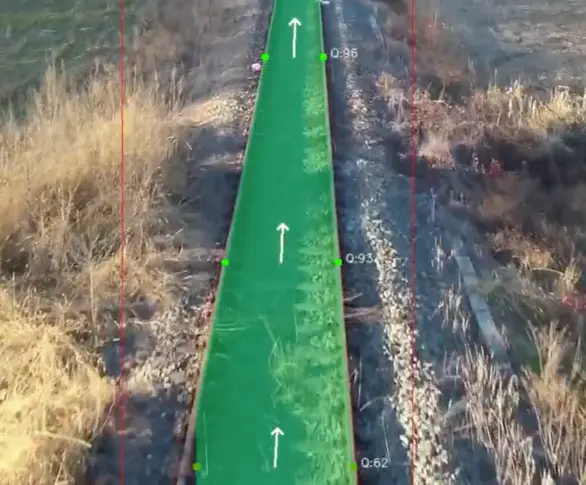
A Python application was developed to test the algorithm on prerecorded videos provided by the client, making it possible to observe the system’s behavior in realistic yet repeatable scenarios. This validation environment made it possible to extract frames, invoke the detection API, display graphical overlays on the identified tracks, and objectively measure metrics such as latency, accuracy, and stability.
Working in a controlled setting also made it possible to simulate critical conditions, such as lighting variations, vibrations, and curved sections of track. This provided useful insights both for identifying areas where the algorithm could be improved and for defining the minimum hardware requirements for onboard execution.
Real-Time Pipeline Design
Once the core detection capabilities had been validated, the project moved into a second phase focused on developing a modular software architecture for real-time video processing. The pipeline was divided into independent components dedicated to:
- video stream acquisition
- frame decoding and reconstruction
- asynchronous API invocation
- post-processing with temporal smoothing
- generation of a structured output for the control system
Particular attention was given to reducing end-to-end latency, handling frame drops, stabilizing detection over time, and preparing the data for future integration with the drone’s navigation system.
Architecture
The developed solution consisted of a Python application for validation and testing activities, a modular pipeline for real-time processing, a logging and metrics collection system, and a structured interface to the drone’s control module.
The output generated by the API was not simply returned as a visual detection result, but transformed into navigation-relevant information, including lateral offset from the center of the tracks, curvature estimation, suggested heading correction, and a confidence score associated with the detection. In this way, the vision system became a component that could be concretely integrated into the autonomous guidance logic, rather than remaining an isolated experimental module.
Results
The project enabled the client to objectively validate the algorithm’s performance, identify the minimum hardware requirements, and reduce technical risk before moving to field testing. At the same time, it delivered a pipeline already prepared for onboard integration and laid the groundwork for a scalable software architecture designed to support the solution’s evolution over time.
The modular approach also made it easier to envision future developments, such as integration with autopilot systems, sensor fusion combining vision, IMU, and GPS data, optimization on embedded GPUs, and iterative model training.
Overall, the project provides a concrete example of how computer vision can be applied in an industrial context, how low-latency real-time pipelines can be designed, and how incremental validation can reduce project risk by turning a feasibility study into a concrete, testable architecture ready to evolve.
Vantaggi
- Reliability
The objective validation of the algorithm made it possible to assess stability, latency, and accuracy in realistic scenarios, reducing technical risk before field deployment.
- Integration
The software pipeline was designed to transform the computer vision output into navigation-relevant data, facilitating communication with the drone’s control system.
- Scalability
The modular approach laid the groundwork for future technological developments, from edge computing to sensor fusion, without requiring the architecture to be redesigned from scratch.
Conclusion
This project made it possible to turn a feasibility study into a concrete, validated technological foundation ready for future developments. For the client, this means being able to rely on a solid architecture on which to build an increasingly reliable autonomous navigation system, integrating computer vision and real-time logic into a solution designed for real operating conditions.