Firmware bare-metal vs Yocto: quale scegliere?
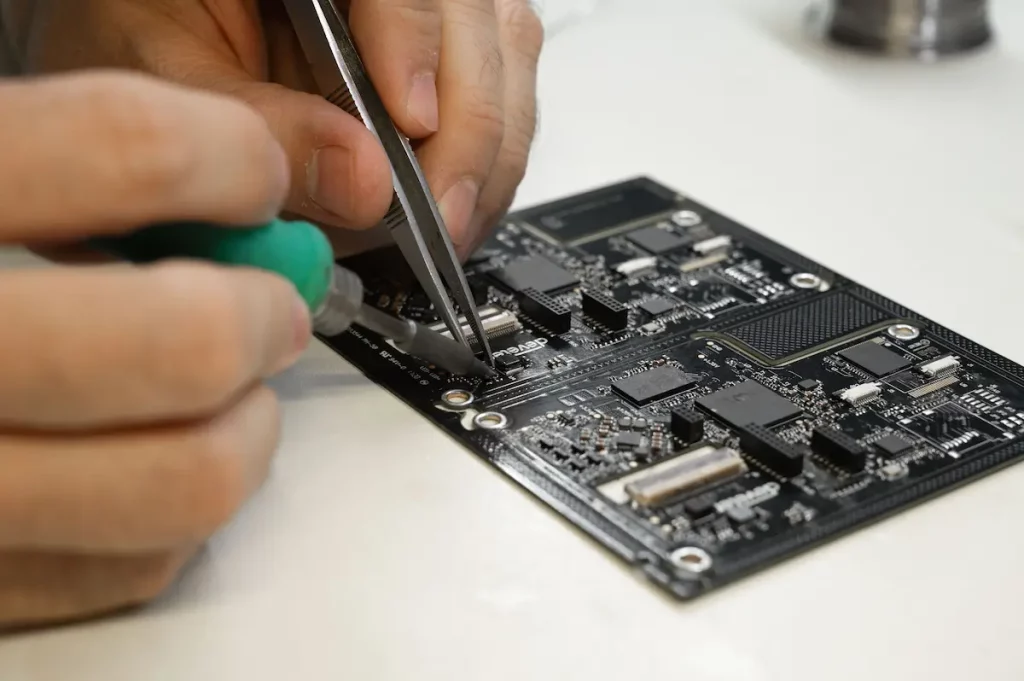
When starting a new embedded project, sooner or later a question comes up – one that may seem simple, yet often shapes the entire product architecture: does it make more sense to develop bare-metal firmware, or to build a custom Linux distribution with Yocto?
The decision is naturally influenced by the available hardware, which often already points toward one of the two approaches. But in general, it’s not just a technological choice: it concerns the very identity of the product – how responsive it needs to be, how complex it should become, how much it will have to grow over time, and what budget will be needed to evolve the software in the long run.
In this article, we try to bring clarity to these themes by explaining what each path really entails, the pros and cons of both, and how to understand which approach best fits the type of device you want to build.
The appeal (and limitations) of bare-metal
Bare-metal firmware is the most essential form of embedded software: the code has full access to the hardware, with no operating system, no scheduler, no abstractions.
This choice immediately offers a key advantage: absolute control over timing.
If the device needs to read sensors at precise intervals, drive motors, or guarantee strict real-time behavior, the absence of an OS is beneficial. Every microsecond is predictable, every interrupt is handled exactly when expected.
Beyond determinism, there’s a matter of resources. A microcontroller with just a few tens of kilobytes of RAM can easily host functional, efficient firmware with extremely low power consumption. This makes it ideal for battery-powered devices or products that must operate for years with minimal energy use.
Still, the bare-metal approach has its compromises. As the product grows and more “system-level” requirements appear – reliable filesystems, OTA updates, strong cryptography, complex protocols, web interfaces – everything an operating system would normally provide becomes something to reimplement manually. And the firmware risks turning into a sort of small, custom OS that is difficult to maintain and expand.
Pro
- Extremely fast boot times
- Excellent determinism and highly predictable latency
- Minimal power consumption and small footprint
- Perfect for hard real-time applications and simple devices
Cons
- Fewer abstractions: a lot of hardware logic must be handled manually
- Advanced features (networking, storage, security) become burdensome
- Limited scalability: difficult to grow the product over time
- More complex debugging and testing when real-time constraints are involved
Yocto: when you need a system, not just firmware
On the opposite side of the spectrum, we find the Yocto Project – a tool that allows you to build a custom Linux distribution tailored to your device.
The idea is simple: select only the components you need and customize the distribution to obtain a system truly optimized for your use case.
The main advantage is access to a full Linux ecosystem: mature networking stacks, journaled filesystems, containers, secure protocols, advanced libraries (from OpenCV to Python), diagnostic tools, systemd services, and more. For a device that needs to connect to the Internet, update securely, or offer rich functionality, Linux is often the most natural choice.
With Yocto, the initial time investment is quite high, but long-term maintenance becomes easier and more predictable, as the entire system can be easily vendorized. Updates are handled through layers and patches; builds are reproducible and easily integrated into CI/CD systems; dependencies are easily controlled.
Of course, it’s not all straightforward. Yocto requires specific expertise, very heavy builds, and more powerful hardware compared to a microcontroller. Additionally, boot times are slower, and hard real-time still requires dedicated components (or hybrid approaches).
Pro
- Full and mature Linux ecosystem
- Highly scalable and maintainable over time
- Excellent for devices with UI, networking, and complex functionality
- Wide availability of ready-to-use applications and libraries
Cons
- Steep learning curve (BitBake, layers, recipes)
- Very long build times, especially for the first build
- Requires higher CPU, RAM, and storage compared to an MCU
- Slower boot and lower native determinism
Two ways of thinking about the product
One of the most important points, which often emerges in the projects we handle at Develer, is that the discussion is rarely “bare-metal or Yocto,” but rather “what kind of product are we building?”.
If the goal is to create an extremely responsive, low-power device that will not need to evolve much over time, bare-metal is a powerful ally.
If instead we envision a product with periodic updates, advanced connectivity, robust protocols, security features, UI, or functionalities that will change over the years, a Linux-based foundation built with Yocto tends to be the more solid infrastructure.
And then there are hybrid cases, increasingly common: a microcontroller for the real-time part, and a SoC running Linux to handle communication, storage, and user experience. This approach allows optimization of costs, performance, and scalability without forcing excessive compromises.
Conclusion
Bare-metal and Yocto represent two very different visions of embedded development: one aims for maximum essentiality, the other for the ability to grow with the product.
The choice is not philosophical, but based on concrete requirements: determinism, system complexity, update needs, power consumption, maintenance costs, and long-term evolution.
Understanding these elements well – before writing even a single line of code – is often what makes the difference between a product that works today and one that still works well five years from now.
At Develer, we work daily on projects involving bare-metal firmware, embedded Linux systems based on Yocto, and hybrid architectures. We know the strengths, limitations, and implications of both technologies because we use them extensively in real-world industrial contexts.
For this reason, we can support you in choosing and designing the architecture best suited to your product, evaluating costs, timelines, risks, and future growth potential.
If you are designing a new embedded device – or rethinking the evolution of an existing one – we can discuss your needs and determine the most effective path forward.
Do you want to learn Yocto?
Discover Develer’s Yocto course